
Summary
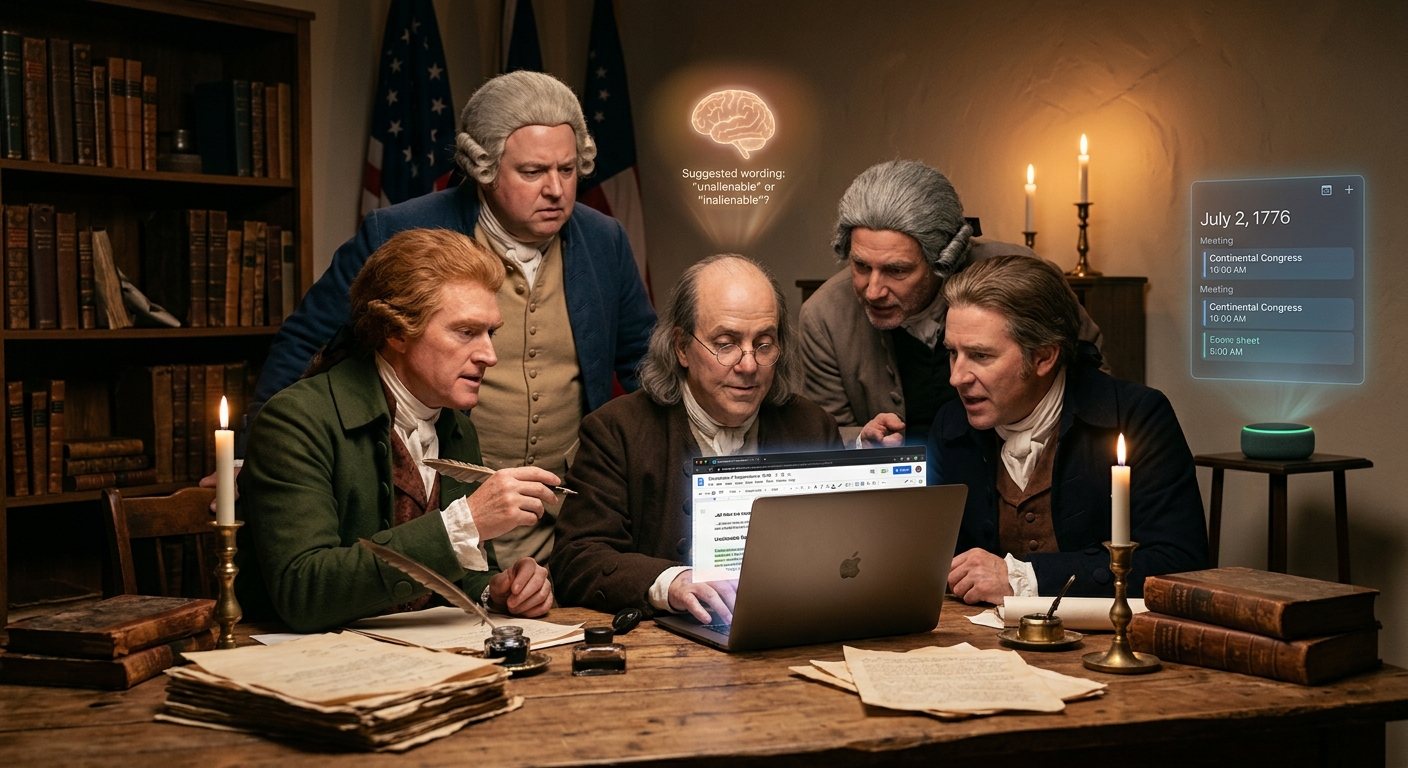
Google’s new commercial, released to mark the America 250 anniversary, creatively reimagines the drafting of the Declaration of Independence through the lens of modern AI-assisted tools such as Google Docs, Calendar, Meet, and eSignatures. The advertisement envisions the Founding Fathers collaborating with AI-powered applications, including Google’s Gemini model, to streamline the historic process, highlighting how contemporary technology could transform complex teamwork and creative workflows. This campaign stands out for blending a pivotal moment in American history with cutting-edge generative AI technology, showcasing Google’s vision of AI as an enabler of productivity and innovation.
The commercial employs a tongue-in-cheek narrative that humanizes AI by depicting historical figures engaging in a “group project, but make it 1776” scenario, using real-time digital communication and AI tools to draft the Declaration. Visually, it features AI-generated video footage that lends the ad an uncanny, glowing aesthetic, reinforcing the futuristic theme. The integration of AI in both the story and production process underscores Google’s efforts to position its Workspace and Gemini AI as practical aids in creative collaboration rather than mere gimmicks.
Reception to the commercial was mixed, with positive feedback on platforms like YouTube and Instagram praising its creativity, while critics on social media, particularly Bluesky, described it as “cringey” and “tone deaf,” especially focusing on the AI elements. Historians and commentators have noted the irony that, despite its AI-centered premise, much of the ad’s content was not genuinely AI-generated, sparking debate about AI’s realistic role in political and creative collaboration. These discussions reflect broader societal ambivalence toward AI’s capabilities and ethical implications in media and public discourse.
Beyond marketing, the commercial invites reflection on the intersection of technology, history, and philosophy by connecting the Founding Fathers’ concept of “self-evident” truths with today’s evolving AI tools. By framing AI as a collaborator in a foundational moment of democracy, the ad provokes questions about authenticity, the role of reason, and how revolutionary technology might shape future governance and creative expression. As such, Google’s campaign is notable not only for its innovative storytelling but also for stimulating critical conversations about AI’s cultural and political significance.
Background
Google’s new commercial, released to coincide with the America 250 anniversary, creatively reimagines the drafting of the Declaration of Independence through the lens of modern AI-assisted tools such as Google Docs, Calendar, Meet, and eSignatures. The ad showcases features like Docs version history, AI-assisted edits, and scheduling prompts, all of which are currently available to Google Workspace users without introducing new products or features. This campaign emphasizes the fusion of historical significance with cutting-edge technology, highlighting how AI can streamline complex collaborative processes in a contemporary context.
The advertisement also reflects a design philosophy rooted in AI’s ability to simplify and synthesize information. This is evident in how AI models distill complex, multi-part queries into relevant, structured responses—a function that Google is exploring as a future model for evolving ad experiences. The ad’s use of AI-generated video footage lends it an uncanny, glowing aesthetic, reinforcing the futuristic aspect of the narrative.
The historical underpinning of the commercial is drawn from the real laborious efforts behind the original Declaration of Independence, which involved clandestine late-night work by printers, precise handwriting by clerks, and the boldness of the founding figures who risked their lives to sign the document. The commercial subtly references the intellectual foundations of the Founding Fathers, particularly their scholastic education that viewed reason as a faculty for discovering a created order rather than creating it anew. This connection bridges the revolutionary spirit of the past with today’s revolutionary technology.
Development of the Commercial
The commercial was developed with a strong emphasis on integrating AI technologies to reimagine a historical moment—the drafting of the Declaration of Independence. The production employed a documentalist style, with reenactments performed by Andreas “Andi” Gremmel, who had a personal connection to the events depicted. Filming took place on location at Schneeberg mountain, near Vienna, to enhance authenticity, and production services were managed by Progressive’s Team.
Central to the commercial’s creative process was the use of Google’s AI tools, particularly Gemini. The fictionalized Founding Fathers interacted with AI-driven applications such as the “help me visualize” tool to experiment with various design elements for the national seal, while Gemini took notes and offered chatbot advice during pivotal scenes. This integration aimed to showcase AI’s potential in augmenting historical storytelling and collaborative workflows.
Behind the scenes, the production leveraged Google AI to significantly streamline the workflow. According to the production team, AI reduced the typical need to start from scratch for each scene, decreasing the overall production timeline by approximately 400%. This efficiency was crucial given the complex staging, lighting, and art direction required across multiple scenes.
The commercial’s development was iterative, following multiple rounds of testing and refinement before the final release. Such iterative cycles ensured that the integration of AI elements was balanced with narrative cohesion, acknowledging that the process from concept to launch is rarely linear.
Despite the AI integration being relatively discreet compared to other recent advertisements, the use of AI-generated video footage gave the commercial an uncanny aesthetic that drew mixed reactions. While some viewers on platforms like YouTube and Instagram responded positively, critics on Bluesky described the commercial as “cringey” and “stunningly tone deaf,” with the AI aspect being the primary focus of criticism. Nevertheless, some experts noted the surprising scarcity of actual AI-generated content within the ad, underscoring the nuanced role AI played in its creation.
Content and Themes
Google’s commercial, set 250 years after the signing of the Declaration of Independence, imagines a scenario in which the Founding Fathers have access to modern technology, specifically Google Workspace and Gemini AI. The ad centers around a largely unseen Thomas Jefferson drafting the Declaration when he receives a persistent message from Benjamin Franklin, prompting a highly Google-centric collaborative process. The tagline, “Group project, but make it 1776,” encapsulates this blending of historical context with contemporary digital tools.
The commercial adopts a tongue-in-cheek tone, featuring lighthearted moments such as Sam Adams suggesting, “Can we settle this over beers?” The use of AI is relatively subtle compared to other recent Google advertisements, avoiding overt claims that AI improves the text of the Declaration itself. Within the narrative, AI tools like Google’s “help me visualize” assist the fictional founders in experimenting with different animal designs for the national seal, while Gemini takes notes and a chatbot offers advice during the meeting—actions that emphasize AI’s role as a supportive collaborator rather than a dominant force.
Visually, the ad incorporates footage with an uncanny glow suggestive of AI-generated video, enhancing the futuristic atmosphere. While the commercial has garnered mostly positive reactions on platforms like YouTube and Instagram, it faced criticism on Bluesky, where users described it as “cringey” and “stunningly tone deaf.” The AI element was a primary target of these critiques, although some commentators, including historian Angus Johnston, noted ironically how little of the ad’s content was genuinely AI-generated. Johnston expressed skepticism regarding AI’s practical utility in political organizing or human collaboration, even within the context of a humorous fantasy scenario.
Thematically, the commercial explores the intersection of technology and history, raising questions about how revolutionary ideals might be shaped by modern digital tools. It juxtaposes the gravitas of a foundational political document with the casual, collaborative style facilitated by Google’s AI and productivity platforms, thereby highlighting both the potential and limitations of AI-assisted creativity and teamwork in historical and contemporary contexts.
Marketing and Strategic Messaging
Google’s new commercial, which envisions a modern, AI-assisted rewriting of the Declaration of Independence, serves as a compelling example of the company’s innovative approach to marketing and strategic messaging. By blending historical context with contemporary technology, the ad not only showcases the capabilities of Google Workspace and Gemini AI but also positions Google at the forefront of AI-driven productivity tools. This creative approach highlights how generative AI can be integrated into everyday professional tasks, reinforcing Google’s narrative around seamless, intelligent assistance.
The commercial employs a unique storytelling technique, depicting founding fathers like Thomas Jefferson receiving real-time input from Benjamin Franklin via modern messaging, thereby bridging the gap between past and present technology. This narrative strategy effectively humanizes AI and makes the concept of advanced AI tools more accessible and relatable to a broad audience. Moreover, Google’s decision to use an animated character rather than realistic human figures avoids the “uncanny valley” effect seen in other AI ads, setting the campaign apart and ensuring a more positive reception.
Strategically, the campaign taps into nostalgia while simultaneously showcasing innovation, as seen in Google’s broader AI initiatives that mix historical reimaginings with cutting-edge generative technology. This duality appeals to users’ sense of familiarity and curiosity, enhancing engagement and memorability. The ad also reflects Google’s broader marketing trend of emphasizing AI as an enabler of creativity and productivity rather than as a standalone gimmick, which aligns with the company’s larger goal of integrating AI meaningfully into everyday workflows.
However, audience reactions have been mixed, with some viewers praising the creativity and execution, while others criticize the ad for perceived tone-deafness or the extent of AI involvement. This split underscores the ongoing challenge for marketers in balancing innovative messaging with public perception and highlights the importance of nuanced, data-driven strategies in AI-related advertising.
Reception
Google’s new commercial envisioning an AI-assisted Declaration of Independence received a mixed reception from audiences and critics alike. The most striking and frequently discussed aspect of the ad was its use of AI-generated footage, which gave the video an uncanny glow that many viewers found either impressive or unsettling. While the commercial was generally well-received on platforms like YouTube and Instagram, where comments tended to be mostly positive, the response on Bluesky was notably more critical.
On Bluesky, users described the commercial as “cringey” and “stunningly tone deaf,” particularly targeting the AI element of the ad as its weakest point. Some critics, including historian Angus Johnston, highlighted the irony in the campaign by noting how little of the commercial actually employed AI, despite its central theme. Johnston also expressed skepticism about AI’s practical usefulness in political organizing, writing, or human collaboration, suggesting that the ad’s portrayal of AI was more fantasy than reality.
Despite the divided opinions on the creative execution, the commercial tapped into broader conversations about AI’s role in communication and decision-making, echoing ongoing trends where AI increasingly influences consumer behavior and marketing strategies. However, the ad also underscored the challenges companies face in authentically integrating AI into their messaging without alienating skeptical audiences.
Ethical Considerations and Audience Engagement
Google’s new commercial featuring an AI-assisted reimagining of the Declaration of Independence has sparked considerable debate regarding the ethical implications of using artificial intelligence in the context of historical and political narratives. Critics have described the commercial as “cringey” and “stunningly tone deaf,” particularly targeting the portrayal of AI’s role in political organizing and writing. Historian Angus Johnston notably remarked that it is “impossible to make the case that AI is a useful tool for political organizing, writing, or human collaboration,” even within the context of a “corny fantasy joke”. This skepticism highlights a broader concern about overestimating AI’s capabilities in domains requiring nuanced human judgment and ethical sensitivity.
From an ethical standpoint, the use of AI-generated content in public discourse raises questions about accuracy, accountability, and the potential impact on public opinion. In a related legal context, a German court ruling emphasized that AI tools’ false outputs, especially when connected to commercial activities, can influence public perception and must be carefully managed. The court concluded that the interests of publishers in removing false information outweighed the commercial speech rights of platforms like Google, underscoring the responsibility of AI providers to mitigate misinformation.
Google has also demonstrated awareness of ethical responsibilities through its collaborations with nonprofits and initiatives such as the Google.org Fellowship, which channels company resources and employee expertise towards socially beneficial causes. These efforts, including partnerships with organizations like the National Center for Missing and Exploited Children, reflect a commitment to leveraging technology in a manner aligned with broader societal values.
Audience engagement with the commercial has been mixed, with reactions ranging from amusement to critical reflection on AI’s role in shaping historical narratives and contemporary political processes. While some viewers appreciate the innovative approach, others question the appropriateness and effectiveness of AI in these contexts, indicating a need for thoughtful integration of AI that respects both historical integrity and public sensibilities.
Significance
Google’s new commercial, which reimagines the drafting of the Declaration of Independence with the assistance of AI, holds significant cultural and technological implications. By blending a pivotal moment in American history with modern AI tools, the ad prompts viewers to consider how transformative technologies might intersect with foundational historical events. This fusion serves not only as a creative marketing strategy but also invites reflection on the evolving role of AI in society and governance.
The commercial’s depiction of Thomas Jefferson using AI-powered tools to craft the Declaration highlights how AI can augment creativity and productivity, echoing broader trends in marketing and enterprise where generative AI is increasingly employed to enhance workflows and creative processes. For instance, AI’s capacity to reduce production timelines and generate immersive visual assets aligns with the innovative spirit showcased in the ad. This positions Google as a pioneer in integrating AI into both historical narrative and contemporary business solutions, underscoring AI’s expanding influence across domains.
Moreover, the ad sparks dialogue about authenticity and reception in AI-driven media. While many viewers have praised the commercial’s innovative use of AI-generated footage, others have criticized it as “cringey” and “tone deaf,” reflecting broader societal ambivalence toward AI’s role in media and communication. This tension underscores the ongoing challenges brands face in balancing technological novelty with meaningful engagement.
Beyond marketing, the commercial implicitly connects to deeper philosophical questions about the nature of reason and self-evidence, concepts central to the Founding Fathers’ worldview. The Founders’ notion of “self-evident” truths was rooted in a reason aligned with a created order, not subjective opinion, which adds layers of complexity when considering how AI might interpret or replicate such principles. By staging a dialogue between historical context and futuristic technology, the commercial invites audiences to rethink how tools like AI might shape interpretation, creation, and even governance in the modern era.
In sum, Google’s commercial is significant not only as an advertising campaign but as a cultural artifact that bridges history, technology, and philosophy. It showcases AI’s potential to transform creative and professional domains while simultaneously provoking critical conversations about authenticity, reception, and the enduring values underpinning American democracy.
The content is provided by Jordan Fields, 8 Minute Read