Summary
Flipkart, one of India’s leading e-commerce platforms, has significantly boosted its fast delivery services as part of a strategic effort led by its majority owner Walmart to intensify competition against Amazon in the rapidly growing Indian market. Since Walmart’s $16 billion acquisition of a controlling stake in Flipkart in 2018, the company has leveraged advanced logistics infrastructure, including a network of micro-fulfillment centers and hyperlocal hubs, to offer ultra-quick delivery options such as the “Flipkart Minutes” service promising deliveries within 8 to 16 minutes. This rapid delivery capability aims to meet rising consumer expectations driven by increased internet penetration, smartphone adoption, and demand for convenience across both urban and semi-urban areas.
Flipkart’s fast delivery ecosystem is underpinned by its in-house logistics arm Ekart, sophisticated route optimization technologies, and strategic partnerships—including with India Post—to expand reach beyond metropolitan centers. The company employs a hybrid model combining large fulfillment centers with smaller, localized dark stores stocked with high-demand essentials, which helps balance speed, cost, and inventory flexibility. Walmart’s global expertise and investment have accelerated Flipkart’s supply chain enhancements, enabling it to compete more effectively with Amazon, whose own quick commerce arm, Amazon Now, operates a vast network of micro-fulfillment centers and has introduced innovations like electric delivery fleets.
The rivalry between Flipkart and Amazon has transformed India’s quick commerce sector into a fiercely contested market, where both players continuously innovate to capture growing consumer demand for instant deliveries. Challenges persist, including the high costs of scaling ultra-fast delivery infrastructure, geographic and logistical complexities in rural and semi-urban areas, and profitability pressures amid intense competition. Nevertheless, the sector’s projected growth at a CAGR of 17% through 2027 underscores the enormous opportunity as e-commerce expands beyond traditional categories to encompass groceries, electronics, personal care, and more.
Looking forward, Flipkart’s delivery strategy is expected to focus on further operational efficiencies, customer-centric innovations, and expansion into smaller towns supported by government initiatives like the National Logistics Policy and the Open Network for Digital Commerce (ONDC). Walmart’s continued backing positions Flipkart to maintain its competitive edge and adapt to evolving market dynamics in India’s fast-evolving digital economy.
Background
Flipkart, founded in 2007 as one of India’s pioneering e-commerce marketplaces, has played a pivotal role in shaping the country’s digital retail landscape. Its growth trajectory underwent a major transformation following Walmart’s $16 billion acquisition of approximately 77% stake in May 2018. This acquisition marked a significant milestone, integrating Flipkart into Walmart’s global operations while positioning it to better respond to the rapidly evolving Indian market.
The Indian e-commerce market has seen rapid expansion driven by increasing internet penetration, smartphone adoption, and digital payments, which have collectively heightened consumer expectations for convenience, trust, and delivery reliability. Alongside this growth, the rise of quick-commerce has emerged as a critical area of competition, with consumers demanding ultra-fast deliveries and seamless shopping experiences. Flipkart’s early investment in quick-commerce through the deployment of dark stores—small, strategically located warehouses stocking high-demand essentials such as groceries, personal care products, and household supplies—has been integral to its strategy to meet these expectations.
This expansion in quick-commerce comes amid intensifying competition from Amazon, which entered India’s rapid delivery market in late 2024 and has aggressively scaled its own network of dark stores to meet consumer demand for speed and convenience. The competition has reshaped the landscape, transforming quick-commerce from a startup-driven sector into one dominated by major players, leading to increased consolidation and innovation in delivery models.
In addition to competition from Amazon, Flipkart operates within a broader retail ecosystem experiencing significant shifts, including rising operational costs and the growing importance of logistics and delivery efficiency. The strategic use of technologies such as generative AI to optimize inventory placement and routing in dark stores illustrates Flipkart’s focus on improving unit economics and enhancing customer retention through frequent, high-touchpoint engagement. Meanwhile, safety and operational efficiency in micro-fulfillment centers remain priorities to support ultra-fast delivery capabilities.
Flipkart’s Fast Delivery Services
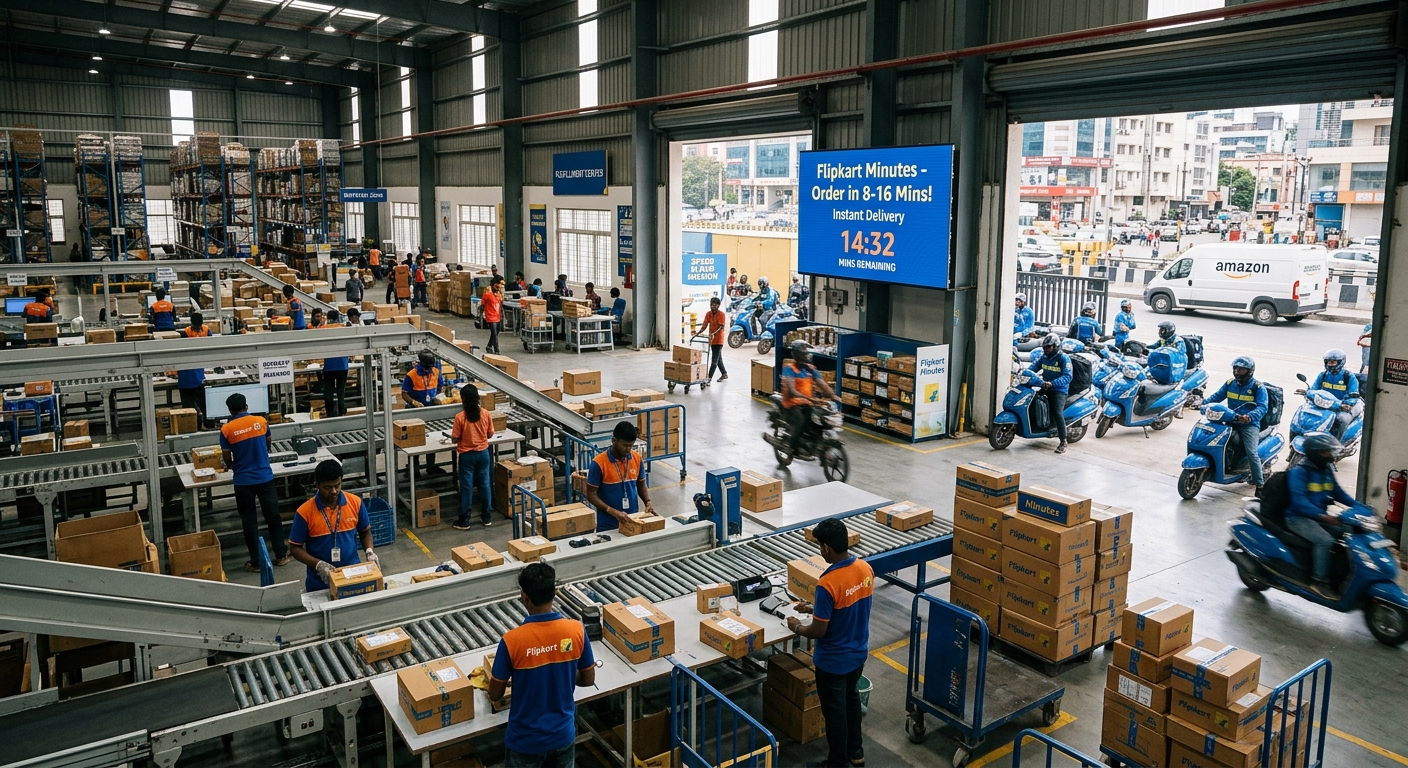
Flipkart has significantly enhanced its fast delivery capabilities to meet the growing demand for ultra-quick order fulfillment in India’s competitive e-commerce market. Central to this effort is the introduction of Flipkart Minutes, a swift delivery service integrated into the Flipkart app that promises delivery within 8 to 16 minutes for a wide range of products, including groceries, electronics, and cellphones. This initiative builds upon the company’s earlier venture, Flipkart Quick, which offered 90-minute deliveries and expanded across 14 cities, with plans for broader rollout.
At the core of Flipkart’s fast delivery ecosystem lies a sophisticated logistics network powered by its in-house logistics arm, Ekart. Ekart manages the transit and delivery of orders using technology-driven route optimization, trained delivery agents, and a hybrid network of large fulfilment centers combined with agile hyperlocal hubs. This model supports rapid deliveries not only in metro cities but also in semi-urban and remote locations across India. The logistics infrastructure includes multiple fulfilment centers, sortation hubs, and last-mile delivery partners, facilitating same-day and next-day courier options, and enabling real-time order tracking and precise estimated delivery dates for customers.
Flipkart’s fast delivery services also leverage data analytics and automated workflows to optimize inventory placement and minimize failed deliveries and returns. The company employs a modular micro-fulfillment strategy that scales capacity based on demand signals rather than relying solely on large warehouses, allowing greater flexibility and cost efficiency during peak periods. This technology-driven approach helps balance delivery speed against operational costs while maintaining consistent service quality across diverse regions.
To address the complexities of quick commerce and nationwide parcel movement, Flipkart combines internal logistics capabilities with strategic partnerships, including collaboration with India Post to enhance reach into semi-urban and rural markets. This dual approach helps preserve capital while expanding delivery coverage and improving operational coordination across more than 24,000 pin codes. Government initiatives aimed at improving digital infrastructure and logistics under the National Logistics Policy further support Flipkart’s efforts to provide reliable and swift delivery services across the country.
Walmart’s Role in Enhancing Fast Delivery
Walmart has played a pivotal role in accelerating Flipkart’s fast delivery capabilities, significantly enhancing its competitive position against Amazon in India’s e-commerce market. Following Walmart’s acquisition of a controlling stake in Flipkart, the retail giant gained access to one of the largest logistics networks in India, which has been instrumental in improving Flipkart’s supply chain efficiency and delivery timelines.
John Furner, Walmart Inc President and CEO, highlighted the impressive speed of Flipkart’s delivery services during the Q1 FY 2027 earnings call, noting that Flipkart’s innovative approach, including over 800 micro-fulfilment centres, enables delivery within an average of 13 minutes through its “Flipkart Minutes” service. This rapid delivery model is a direct result of Walmart’s investment and strategic focus on expanding and optimizing Flipkart’s logistics infrastructure.
The integration of Flipkart’s logistics network with Walmart’s global expertise has led to operational improvements such as nationwide storage footprints that position inventory closer to customers, thereby reducing delivery times and enhancing customer satisfaction. Additionally, Walmart continues to monitor evolving consumer trends and the quick commerce landscape in India, indicating a sustained commitment to exploring new opportunities that support instant shopping and seamless online experiences.
By strengthening Flipkart’s scale and logistics efficiency, Walmart has not only boosted the company’s delivery speed but has also helped it maintain competitive leadership in the fast-growing Indian e-commerce sector. This development reflects Walmart’s broader strategy to innovate continuously and adapt to local market needs, which is critical for success in India’s dynamic digital economy.
Competitive Dynamics with Amazon India
Flipkart has intensified its efforts to enhance fast delivery services in India, positioning itself strongly against Amazon’s expansive logistics and fulfillment network. With the launch of Flipkart Minutes, a 10-minute delivery service covering groceries, electronics, and daily essentials, Flipkart has redefined consumer expectations by offering near-instant product availability, thereby stimulating impulse purchases and increasing customer satisfaction. This move highlights Flipkart’s strategic focus on speed and convenience to capture a larger share of India’s rapidly growing e-commerce market.
In response, Amazon India has leveraged over a decade of long-term investments in technology, infrastructure, and human resources to build one of the country’s fastest and most reliable fulfillment networks. Amazon Now, Amazon’s quick commerce arm, emphasizes spacious, hygienic, and operationally efficient micro-fulfillment centers that enable ultra-fast deliveries within minutes. Unlike typical “dark stores,” these centers are designed to maintain both safety and speed. Furthermore, Amazon India is pioneering sustainability in logistics by deploying approximately 1,000 electric trucks in partnership with Eicher Trucks and Buses, marking one of India’s largest dedicated electric fleets in e-commerce.
While Amazon focuses on integrating advanced AI-driven inventory planning and demand forecasting to optimize operations, Flipkart adopts a hybrid and asset-light logistics approach through strategic partnerships, notably with the Indian Department of Posts. This collaboration aims to enhance delivery reach across smaller towns and rural regions where infrastructure gaps and lower shipment density increase logistics costs. Flipkart’s logistics model is a complex network combining warehouses, fulfillment centers, last-mile delivery services, and technology orchestration rather than relying on a single courier or warehouse.
Both companies face challenges inherent to India’s diverse geography and varying infrastructure quality, which impact delivery speed and reliability. Amazon has contended with increased variability in packaging, delivery speeds, and returns due to marketplace scale and the heterogeneity of sellers and logistics partners. Additionally, intensified profitability pressures have forced Amazon to reconsider subsidies on logistics and customer policies. Meanwhile, Flipkart continues to innovate in customer payment options, such as the popular cash on delivery system, which has resonated with Indian consumers and increased competitive pressure on Amazon.
Technological advancements in logistics, such as real-time tracking, accurate delivery estimates, and automated workflow management, have become crucial competitive tools. Companies like WareIQ provide multi-channel fulfillment platforms that integrate seamlessly with e-commerce storefronts to support same-day or next-day deliveries and minimize failed delivery attempts, further elevating customer expectations for reliability and transparency.
Challenges and Opportunities in Fast Delivery Expansion
The expansion of fast delivery services in India presents a complex landscape of challenges and opportunities for e-commerce players like Flipkart, especially as Walmart intensifies competition against Amazon. One of the primary challenges lies in the significant investment required to build and scale ultra-fast delivery infrastructure. Implementing models such as the 15-minute delivery service demands balancing rapid delivery speeds with maintaining a wide product selection and competitive pricing, which often involves trade-offs between speed, variety, and value.
Geographical factors further complicate the expansion. Deliveries to semi-urban and rural areas tend to be more expensive due to lower shipment densities and uneven infrastructure utilization. These regions often face limitations in transport and warehousing infrastructure, slowing delivery times. To mitigate these issues, strategic partnerships and the adoption of micro-fulfillment centers—smaller, localized hubs—are increasingly being employed to bridge logistical gaps and enhance operational efficiency. The Indian government’s initiatives, such as the National Logistics Policy, aim to support these efforts by improving logistics frameworks, thereby enabling e-commerce companies to extend faster delivery services beyond urban centers and tap into tier 2 and tier 3 markets.
Despite these obstacles, the growth potential in fast delivery is substantial. The sector is projected to expand at a compound annual growth rate (CAGR) of 17% between 2023 and 2027, fueled by rising internet penetration, increased smartphone usage, and shifting consumer behaviors favoring convenience and immediacy. Urbanization drives demand for reliable and swift deliveries, while consumer interest is expanding beyond groceries to include electronics, beauty, and personal care products, reflecting a broadening market base.
Flipkart’s previous ventures, like Flipkart Quick offering 90-minute deliveries, laid groundwork for more ambitious fast-commerce initiatives. The company’s strategy to embed inventory closer to customers, as evidenced by a 33% increase in demand following integration with Ekart’s warehousing network, highlights the direct impact faster delivery promises have on customer confidence and sales. However, the push for faster deliveries also raises concerns over increased workloads for delivery personnel, with companies taking steps to mitigate these effects, including addressing weather-related challenges.
Competition in the quick commerce segment is intensifying, with Walmart’s Flipkart noting that quick commerce already accounts for 20% of India’s e-commerce market and is growing at 50% annually. This rapid growth underscores the necessity for continuous innovation and strategic investment. Yet, profitability pressures remain high, as companies balance the costs of quick delivery with the need to scale efficiently in a crowded marketplace.
Future Outlook
The future of Flipkart’s delivery services is set to focus on creating a seamless and highly efficient customer experience that goes beyond mere satisfaction to delight. With increasing competition in India’s e-commerce sector, companies including Flipkart are expected to refine their delivery strategies by incorporating expedited delivery options, flexible time slots, and proactive order status communication to better meet rising consumer expectations. This approach aims to continuously adapt to customer feedback and preferences, ensuring that logistics operations remain agile and responsive.
The Indian quick commerce market is poised for rapid expansion, projected to grow at a compound annual growth rate (CAGR) of 17% between 2023 and 2027. This growth is driven by factors such as increased internet penetration, smartphone usage, evolving consumer behavior, and accelerating urbanization, which demands faster and more reliable delivery services. India’s instant commerce revolution is gaining momentum, fueled by surging demand, intense competition, and significant investment capital. Major players like Flipkart, backed by Walmart, are aggressively expanding their hyperlocal warehousing and delivery capabilities to promise deliveries within minutes in metropolitan areas.
As Flipkart continues to evolve, the expansion of quick commerce services into smaller towns and rural regions is anticipated. Initiatives like the Open Network for Digital Commerce (ONDC) are expected to facilitate this growth, potentially reshaping the competitive landscape and democratizing access to rapid delivery across India. This expansion aligns with the projected sector growth to USD 400 billion by 2030, driven by rising digital access and a new wave of online consumers from diverse demographics.
The competition between Flipkart and Amazon remains intense, with both companies racing to capture market share in a crowded, yet still developing, market. Despite profitability challenges, the demand for fast delivery continues to grow significantly, forcing players to innovate constantly and improve operational efficiencies. Walmart’s ownership of Flipkart has injected strategic discipline and scale advantages, allowing the company to strengthen its logistics network and maintain competitive leadership in India’s evolving e-commerce landscape.
Looking ahead, Walmart and Flipkart are expected to double down on these fast-delivery bets, focusing on operational improvements and strategic investments in sectors like healthcare and travel while preparing for a potential public listing. The ability to understand local consumer needs and deliver seamless online experiences will be critical for sustained success in India’s digital economy and quick commerce sector.
The content is provided by Harper Eastwood, 8 Minute Read