
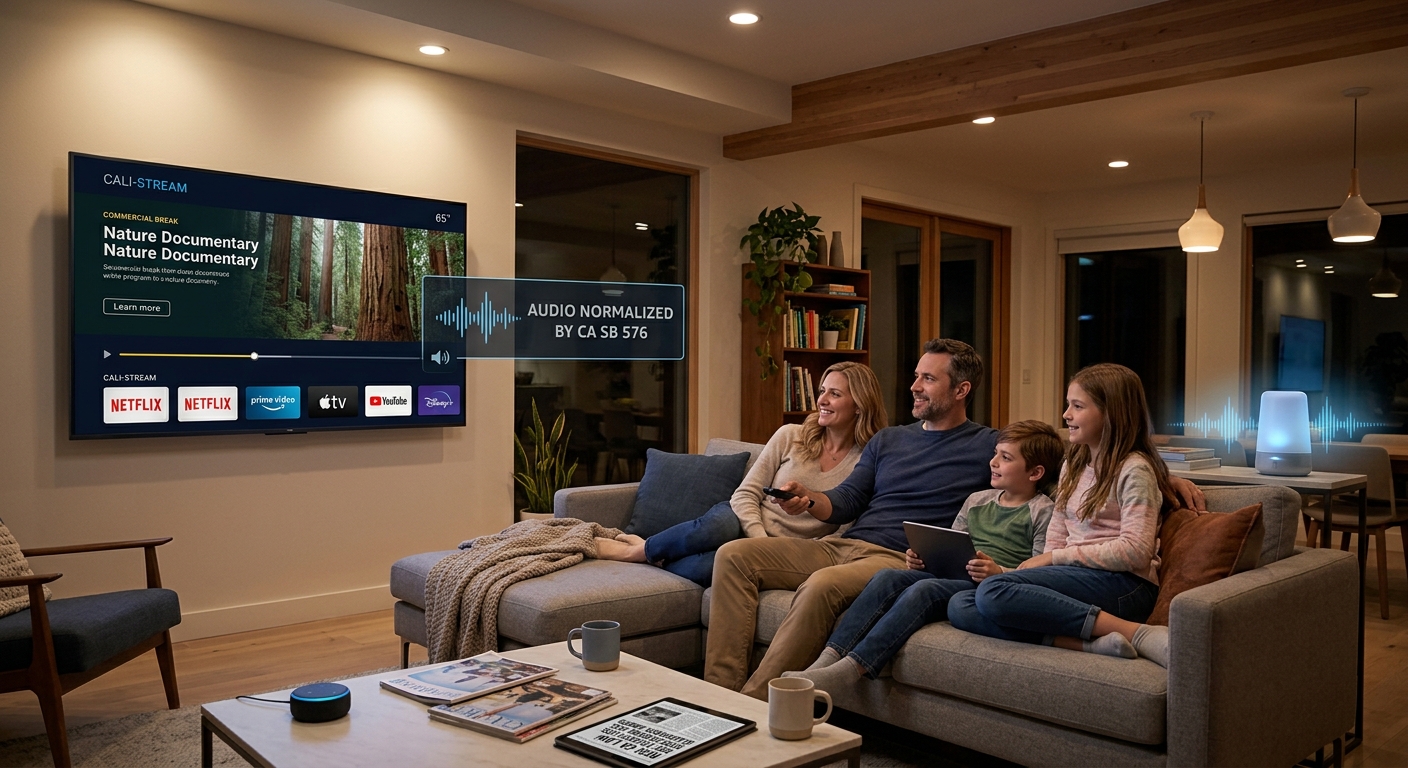
Summary
California’s Senate Bill 576 (SB 576), which takes effect on July 1, 2026, is the first state-level legislation in the United States to regulate the volume of advertisements on streaming platforms, aiming to eliminate disruptive loudness spikes during commercial breaks. Building on the principles of the federal Commercial Advertisement Loudness Mitigation (CALM) Act of 2010—which applied only to broadcast and cable television—SB 576 extends these protections to digital streaming services, addressing a regulatory gap left by stalled federal efforts such as the CALM Modernization Act. The law requires that ads on streaming platforms be no louder than the surrounding program content, mandating the use of audio-normalization technologies similar to those employed in traditional broadcasting.
This legislation reflects California’s proactive approach to consumer protection in the evolving media landscape, responding to widespread viewer complaints about sudden and jarring volume increases during streaming ads. Enforcement is entrusted to the California Energy Commission and the Attorney General’s Office, with noncompliance subject to penalties under the Communications Act framework. The law also anticipates significant technical challenges for streaming providers, particularly in managing loudness normalization across diverse ad insertion methods and playback devices, marking a shift from broadcast engineering to a complex ad-tech supply chain issue.
Industry response has been mixed. While many consumers and advocacy groups have welcomed the law as a long-overdue safeguard, major industry representatives—including the Motion Picture Association—have criticized it as unnecessary, arguing that streaming platforms are voluntarily addressing loudness concerns. Nonetheless, California’s move has sparked discussion about potential broader adoption of similar regulations, as seen in Illinois’s recent passage of comparable legislation set to take effect in 2027.
SB 576 thus represents a notable regulatory innovation that could influence national policy and industry standards as streaming continues to dominate television consumption. It highlights ongoing tensions between consumer advocacy, technological complexity, and industry self-regulation in the digital advertising ecosystem.
Background
The regulation of commercial advertisement loudness in broadcast and cable television has been governed by the Commercial Advertisement Loudness Mitigation (CALM) Act of 2010, which aimed to prevent sudden volume spikes during ad breaks. However, this federal law did not extend to streaming platforms, leaving a regulatory gap as streaming services grew in popularity. To address this, the U.S. Congress introduced the CALM Modernization Act (S 1127), which sought to update the original law to include ad-supported streaming services and empower the Federal Communications Commission (FCC) to enforce loudness standards across all major platforms. Despite its clear intent, the CALM Modernization Act stalled in Congress, delaying a nationwide approach to the issue.
In response to this legislative impasse at the federal level, California took independent action. On October 6, 2025, Governor Gavin Newsom signed Senate Bill 576 (SB 576) into law, effectively extending the protections of the CALM Act to streaming platforms serving consumers in California. This law prohibits streaming services from transmitting commercials at volumes louder than the primary content starting July 1, 2026. SB 576 closes the loophole that had exempted streaming services from loudness regulations, making California the first state to impose such standards on digital streaming advertisements.
The new regulation mandates that the volume of advertisements must match the perceived loudness of the main program to prevent disruptive volume spikes experienced by viewers. This move aligns streaming platforms with familiar broadcast rules and aims to improve the viewing experience by reducing unexpected loudness increases during ads. While some streaming services have already undertaken efforts to manage ad loudness inconsistencies related to server-side ad insertion, it remains unclear how these platforms will fully comply with California’s law or whether they will apply similar volume controls outside the state. Notably, Illinois has passed a similar bill requiring compliance by July 1, 2027, suggesting a trend toward broader adoption of such regulations.
Legislative Development
In response to growing consumer frustration over the loudness of streaming advertisements, California enacted Senate Bill 576 (SB 576), a pioneering law aimed at regulating the volume of commercials on streaming platforms. Signed into law by Governor Gavin Newsom on October 6, 2025, SB 576 extends the principles of the federal Commercial Advertisement Loudness Mitigation (CALM) Act—originally enacted in 2010 for broadcast and cable television—to the streaming era, closing a significant loophole that had exempted digital services from loudness controls.
While federal efforts to modernize and broaden the CALM Act, such as the CALM Modernization Act, stalled in Congress, California took decisive state-level action to address the issue. This legislative move came amid a broader trend toward increasing transparency and consumer protections in digital media, including measures against hidden fees and misleading pricing practices exemplified by California’s SB 478, which targets “drip pricing” and took effect on July 1, 2024.
SB 576 forms part of a larger regulatory shift wherein states and federal agencies seek to make the digital media marketplace clearer, fairer, and easier to navigate. The bill subjects violations to enforcement under the Communications Act, thereby empowering the Federal Communications Commission (FCC) with stronger tools to address noncompliance. This aligns with ongoing attempts to create platform-agnostic ad loudness rules and enhanced transparency in the streaming industry.
Governor Newsom emphasized the bill’s consumer benefits, highlighting its role in bringing “much-needed peace and quiet” to California households by ensuring that streaming advertisements do not exceed the volume of accompanying programming. SB 576’s passage reflects California’s willingness to lead regulatory innovation in the digital media space, setting a precedent that may influence national standards in the near future.
Key Provisions of SB 576
California’s Senate Bill 576 (SB 576), which takes effect on July 1, 2026, introduces regulations that require streaming platforms to ensure that advertisements do not play louder than the surrounding video content they interrupt. This legislation extends to streaming services the principles established under the 2010 Commercial Advertisement Loudness Mitigation (CALM) Act, which previously applied only to broadcast and cable television.
SB 576 mandates that streaming platforms implement audio-normalization tools or other loudness-control systems similar to those used in broadcast environments, effectively bringing parity between streaming services and traditional television providers in controlling ad volume. The law requires that advertisements must match the average loudness of the programming they accompany, preventing sudden volume spikes during ad breaks that have long frustrated viewers.
To facilitate compliance, streaming services must integrate loudness control into their ad delivery workflows, which may involve both file-based and real-time processing, especially in server-side ad insertion scenarios where volume inconsistencies can arise due to varied encoding pipelines. Moreover, platforms must address challenges related to diverse output devices—such as televisions, tablets, and smartphones—and reprocess legacy content that predates the legislation to meet modern loudness standards based on the ATSC A/85 recommended practices underpinning the CALM Act.
Enforcement of SB 576 will be overseen by the California Energy Commission and the Attorney General’s Office, which will handle compliance monitoring and consumer complaints. The law provides a compliance period until July 1, 2026, allowing streaming services time to adjust their technical infrastructure and sound mastering workflows accordingly.
Additionally, the legislation aligns with federal efforts to extend loudness regulations into the streaming era, such as the proposed CALM Modernization Act, which aims to empower the Federal Communications Commission (FCC) to regulate ad volume across all major platforms nationwide. SB 576 thus represents a significant step in updating consumer protections for the modern media landscape as streaming becomes the predominant method of television consumption in California.
Enforcement and Penalties
California’s new law regulating the volume of commercials on streaming platforms such as Netflix, Hulu, and Amazon Prime takes effect on July 1, 2026. The legislation mandates that advertisements on these services must not be louder than the surrounding program content, aligning streaming services with the Commercial Advertisement Loudness Mitigation (CALM) Act standards previously applied to broadcast and cable.
Enforcement of the law is the responsibility of the California Energy Commission and the Attorney General’s Office, which will handle consumer complaints and oversee compliance. Streaming platforms are required to implement audio-normalization tools or other loudness-control technologies similar to those used in traditional broadcasting to ensure adherence to the volume limits. Companies using approved loudness-control equipment and software will be presumed compliant; however, this presumption can be challenged if complaints arise, with the possibility of review and enforcement action by the regulatory authorities.
Penalties for non-compliance fall under the broader regulatory framework aimed at preventing unfair trade practices and preserving fair competition in the state. While specific fines or sanctions are not detailed in the publicly available summaries, the law empowers state agencies to investigate and act on violations, providing consumer protections in the evolving media landscape where streaming has become the dominant mode of television consumption.
This legislative measure represents California’s effort to bring long-overdue consumer safeguards to streaming media advertising, addressing frustrations related to loud commercials and fostering a more consistent and transparent viewing experience.
Industry Impact and Responses
California’s new loudness regulation, SB 576, which mandates that advertisements must match the perceived volume of the primary content to prevent sudden volume spikes during ad breaks, has had a significant impact on the streaming industry as it takes effect in July 2026. This law represents a shift from traditional broadcast engineering challenges to a complex ad-tech supply chain problem, particularly affecting dynamic ad insertion workflows used by streaming services.
The regulation has prompted streaming platforms to reconsider their ad-supported subscription plans, which have become a major growth engine in the industry by attracting price-sensitive users despite introducing commercial breaks similar to traditional TV. However, implementing consistent loudness control in streaming is complicated by the diverse technical environments involved. Streaming services often rely on server-side ad insertion (SSAI) and client-side ad insertion (CSAI), each presenting unique challenges for loudness normalization. SSAI allows automated loudness processing within the ad stitching pipeline to ensure ads match the surrounding content, whereas CSAI requires normalization at the device level, complicating uniform loudness enforcement and necessitating the preservation of loudness metadata for playback adjustment.
Moreover, the fragmented ad-tech ecosystem—including ad servers, demand-side platforms, supply-side platforms, and programmatic marketplaces—must now integrate loudness normalization before ads enter circulation to comply with the law and reduce compliance risks. This is particularly important as ads originate from various production environments with differing loudness targets and encoding standards, making consistency a major industry challenge.
Local broadcasters and video-on-demand providers face additional hurdles. Broadcasters often depend on third-party SSAI vendors and must ensure these partners adhere to the new requirements. Meanwhile, VOD providers that use CSAI must manage loudness normalization at the device level, further complicating compliance efforts.
The law has also sparked debate among industry stakeholders. The Motion Picture Association, representing major studios such as Disney, Netflix, and Warner Bros. Discovery, has voiced opposition, arguing that streaming services are already voluntarily addressing loud ad issues and that SB 576 is unnecessary. Nevertheless, consumer advocates and state legislators continue to push for broader regulatory reforms aimed not only at loudness control but also at pricing transparency, as exemplified by California’s companion legislation targeting “drip pricing” practices in streaming services.
Implementation and Compliance
California’s new law aimed at regulating loud streaming advertisements takes effect on July 1, 2026, marking a significant shift in how streaming platforms manage audio levels for commercials. The legislation mandates that streaming services implement loudness control systems comparable to those used in traditional broadcast, requiring the use of audio-normalization tools or similar technologies to ensure ads do not exceed the volume of surrounding programming.
Enforcement of the law will be overseen by the California Energy Commission along with the Attorney General’s Office, which will handle compliance monitoring and consumer complaints related to loud ads. This regulatory framework presumes compliance for broadcasters, cable operators, and streaming providers who utilize approved loudness-control equipment and software, though the Federal Communications Commission (FCC) retains authority to review complaints and potentially revoke this presumption if violations occur.
The technical implementation poses considerable challenges for streaming platforms. They must integrate both file-based and real-time loudness processing into server-side ad insertion workflows, aligning with the ATSC A/85 recommended practices that underpin the original Commercial Advertisement Loudness Mitigation (CALM) Act of 2010. Video-on-demand services that rely on client-side ad insertion face additional complexities, as normalization must be managed at the playback device level by preserving loudness metadata to allow volume adjustment during ad playback.
Furthermore, the diversity of encoding methods and the variety of ad sources—each potentially mastered to different loudness standards—complicate consistent compliance. The shift toward dynamic ad insertion, particularly in server-side ad insertion (SSAI) workflows, underscores that loudness control is now an ad-tech supply chain issue rather than purely a broadcast engineering concern. Without standardized loudness normalization at the ad source, client-side ad insertion (CSAI) remains vulnerable to compliance risks.
This legislation emerges amid increasing reliance on ad-supported streaming subscription plans, which have driven a surge in advertising revenue and intensified scrutiny on ad delivery practices. The new requirements aim to close a regulatory gap exposed by the resurgence of loudness spikes in streaming ads, extending protections that broadcasters have long enjoyed to the streaming era.
Consumer response has underscored the importance of this law: in 2024 alone, regulatory bodies received at least 1,700 complaints about loud commercials across broadcast, cable, and satellite services, a marked increase from previous years. The law’s phased enforcement period provides streaming companies time to adjust systems and workflows to meet these standards, promoting a more consistent and less disruptive listening experience for viewers.
Comparative Analysis
California’s SB 576 represents a significant regulatory advancement by extending traditional broadcast loudness standards to streaming platforms, addressing a longstanding gap in consumer protections. Historically, regulations like the Commercial Advertisement Loudness Mitigation (CALM) Act of 2010 applied only to television broadcasters and cable operators, leaving streaming services exempt and consumers vulnerable to disruptive volume spikes during ad breaks. While federal efforts such as the CALM Modernization Act sought to update these rules for the digital era, legislative gridlock at the national level has delayed comprehensive reform.
In contrast, California proactively enacted SB 576, which mandates that advertisements on streaming platforms must match the perceived volume of the surrounding programming. This law, effective July 1, 2026, aims to eliminate abrupt loudness increases that have long frustrated viewers, thereby creating a more consistent and user-friendly experience. By closing the loophole exempting streaming services from loudness controls, California has positioned itself as a regulatory pioneer in adapting traditional media rules to the evolving digital landscape.
Additionally, while the Federal Communications Commission (FCC) has introduced “all-in” pricing transparency rules for cable and satellite providers to address consumer frustration over hidden fees, these policies have yet to encompass streaming platforms. This further highlights California’s role in filling regulatory voids left at the federal level, signaling a shift toward greater consumer protections and industry accountability in streaming media.
From an enforcement perspective, SB 576 empowers regulatory authorities by subjecting violations to provisions under the Communications Act, thus equipping agencies like the FCC with stronger tools to ensure compliance. This contrasts with prior federal proposals that stalled in Congress and underscores the state’s commitment to consumer advocacy and regulatory modernization.
Public and Consumer Reception
The introduction of California’s new law regulating the loudness of streaming advertisements has drawn considerable attention from both consumers and industry stakeholders. Many consumers have expressed relief at the prospect of reduced volume spikes during ad breaks, a longstanding frustration reminiscent of traditional television viewing. However, the broader adoption of tiered subscription models—with cheaper, ad-supported options—has reignited concerns about loud and intrusive commercials for millions of users who have shifted away from premium, ad-free tiers due to recent price hikes across streaming platforms.
Despite these frustrations, industry groups such as the
Future Outlook
The implementation of California’s new law regulating the loudness of advertisements on streaming platforms marks a significant step toward addressing long-standing consumer complaints. As the law takes effect in July 2026, streaming providers are expected to integrate more sophisticated loudness control measures into their ad delivery workflows to ensure commercials are not louder than the accompanying program content.
Industry stakeholders face complex technical challenges due to the diversity of ad insertion methods. Server-side ad insertion (SSAI) allows for centralized loudness normalization but requires enhanced real-time processing to manage ads coming from multiple production environments with varying loudness standards. Conversely, client-side ad insertion (CSAI) demands normalization at the device level, complicating consistent loudness control across the wide array of playback devices such as TVs, tablets, and smartphones.
The law’s prohibition on private lawsuits against streaming services aims to balance regulatory enforcement while limiting litigation risks for platforms. However, uncertainty remains about whether California’s legislation will catalyze a broader national reform effort, as earlier attempts to pass similar federal laws have stalled.
As ad-supported streaming continues to grow rapidly—becoming a major revenue driver for the industry—effective loudness management will be crucial not only for regulatory compliance but also for maintaining user experience and trust. The integration of file-based and real-time loudness processing in ad-tech supply chains is anticipated to become a standard practice across the industry, reflecting a shift in loudness control from a purely broadcast engineering concern to a comprehensive ad-tech challenge.
The content is provided by Jordan Fields, 8 Minute Read