
Summary
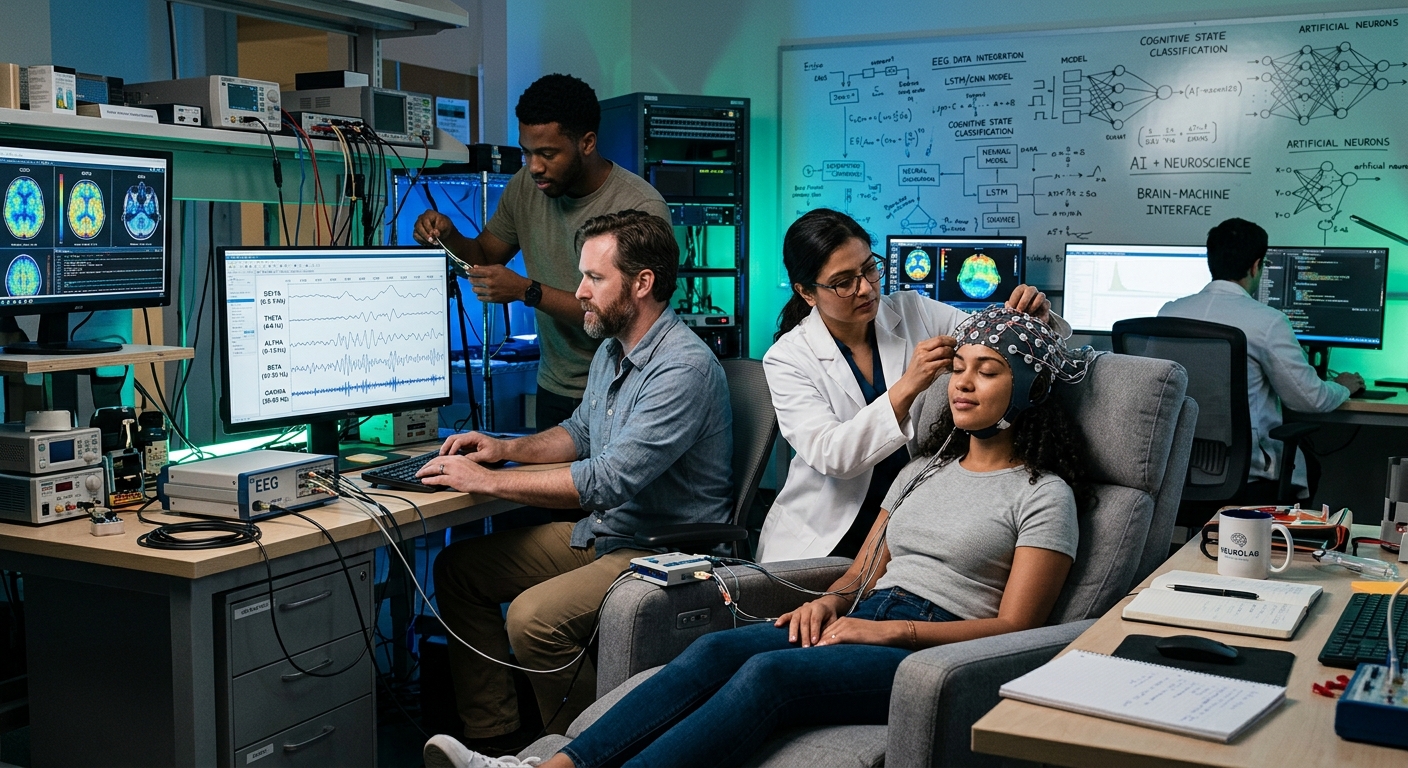
Brain waves consist of electrical patterns produced by neurons interacting in the brain and reflect cognitive and physiological states like attention and sleep. Since their early 20th-century discovery, various methods including electroencephalography (EEG) have allowed researchers to associate different frequency bands—such as delta, theta, alpha, beta, and gamma waves—with specific brain functions. With technological advances, monitoring brain activity has improved, enabling intricate interpretations of neural signals that have led to interactions between brain wave analysis and artificial intelligence (AI), yielding applications like brain-computer interfaces (BCIs) and neural data-driven synthetic communication. However, challenges regarding compatibility, stability, and decoding complexities remain impediments to these advanced systems, alongside ethical considerations surrounding the sensitive nature of neural data. Interdisciplinary efforts focus on improving both technologies and methodologies to unlock the full potential of brain waves for enhanced human-machine interactions.
Background
Brain waves derive from the coordinated activity of large neuron groups, reflecting varied cognitive states and functions. Observed for decades, these rhythmic oscillations span a range of frequencies that correspond to states such as relaxation, concentration, or sleep. EEG effectively captures these oscillations, although it has limitations in spatial resolution and depth sensitivity. The emergence of wearable EEG technology has amplified interest, offering possibilities for controlling devices through thought alone. Furthermore, neural oscillations contribute significantly to brain connectivity and information processing, hinting at their importance in neurological disorders and cognitive functions like memory. The integration of AI and machine learning into this field enhances signal interpretation, supporting the alignment of neural insights with computational advancements.
Brain Wave Measurement Technologies
The landscape of brain wave measurement includes a range of methods vital for analyzing the brain’s oscillating electrical activity. Invasive neural implants offer high-fidelity recordings but face biocompatibility and longevity challenges, necessitating materials that minimize adverse reactions while enhancing performance. Non-invasive techniques like EEG and fNIRS allow for safer monitoring but typically sacrifice some resolution. Meanwhile, minimally invasive technologies bridge these gaps by facilitating deeper signal detection while still limiting surgical risks. The effectiveness of these methods varies, making it essential to weigh the trade-offs between invasiveness, data quality, and user safety.
Signal Processing and Interpretation
The effective application of brain-computer interfaces (BCIs) hinges on accurately decoding brain wave signals to enable meaningful command translation. Effective feature extraction identifies relevant signal patterns, classifying them into mental states or intentions that can control external technologies. The challenge lies in decoding signals from involuntary responses, yet advancements in AI have greatly enhanced interpretations of how dynamic brain waves encapsulate both sensory information and abstract thoughts. Machine learning algorithms adapt to the inherently variable nature of neural inputs, which is crucial for maintaining reliability in neuroprosthetic applications. This intersection between neuroscience and technology emphasizes the need for efficient data management solutions to handle complex neural data generated in high-density recordings.
Brain Waves in Advanced Physical AI Systems
Breakthroughs in recognizing the relationship between brain wave patterns and AI signal processing open avenues for sophisticated physical AI applications. Research indicates that AI mimics the brain’s natural interpretation of stimuli, exemplifying the potential for AI-system architectures that model brain rhythms for improved functionality. BCIs utilizing alpha and beta waves highlight the capability for intuitive human-machine interactions, with applications in communication and technology control. The successful translation of complex brain patterns into comprehensible outputs, including visual reconstructions and artificial speech, signifies the ongoing convergence of neuroscience and AI.
Engineering Challenges
Creating advanced physical AI systems with neural interfacing presents a multifaceted set of engineering and biological obstacles. Ensuring that neural implants remain biocompatible, effective, and compact is paramount but fraught with challenges like thermal management and power supply limitations. These issues necessitate innovative designs using biocompatible materials and miniaturized components while maintaining signal quality and reducing foreign body responses. As the complexity of neural networks increases, managing scalability and the resulting challenges further complicates the pursuit of functional and long-lasting systems capable of supporting sophisticated AI applications.
Biological and Technical Limitations
Several biological factors influence the deployment and efficacy of brain wave technologies within AI systems. For example, the variability in individual brain signals complicates the construction of reliable BCIs, as decoder effectiveness may fluctuate significantly across different users and contexts. On a technical level, delays in neural signal transmission can hinder efficient communication in control systems, making it imperative to improve neural decoder performance and real-time responsiveness. Addressing these limitations through innovative engineering and AI methods is crucial for realizing the full capabilities of brain wave applications in technology.
Ethical, Privacy, and Security Considerations
The fusion of brain wave technologies with AI presents critical ethical issues, notably concerning consent and individual autonomy. The capacity to decode personal cognitive states raises concerns about privacy and the potential for unauthorized access to sensitive neural data. As neural interfaces become more integrated into daily life, robust security measures against hacking and data exploitation are essential. Navigating these ethical landscapes requires deliberate strategies to ensure users are informed, protected, and respected in their engagements with emerging technologies.
Future Directions and Research Opportunities
Exploring new research avenues around brain wave applications in AI systems will be key for advancing technology. Deepening understanding of neural rhythms has profound implications for designing next-generation machine learning algorithms that could enhance performance in AI models. Research must also focus on developing stable, long-duration implants and improving the decoding methods for diverse neural signals. Collaborations between neuroscience, engineering, and AI domains are vital for aligning AI tasks with the biological dynamics of the brain. Addressing data scarcity through generative strategies will also play a significant role in driving innovation forward in this promising intersection.
The content is provided by Avery Redwood, 8 Minute Read